
Who Was Melchizedek in the Bible?
Melchizedek appears briefly in Genesis yet looms large in Scripture as a mysterious priest‑king whose identity points to Christ and invites believers to a deeper understanding of God’s everlasting priesthood.

Introduction: A Brief Figure with Lasting Impact
When a reader first encounters the name Melchizedek in Genesis 14:18‑twenty, the passage is strikingly concise: “And Melchizedek king of Salem brought out bread and wine. He was priest of the Most High God… And Abraham gave him a tenth of everything.” In just three verses, the Bible introduces a king‑priest who blesses Abram and receives a tithe, without any genealogy or background. This enigmatic figure has fascinated scholars and believers for centuries because the text deliberately leaves his origins open, inviting a theological exploration that stretches from the Old Testament to the New.
Melchizedek in Genesis: King of Salem and Priest of the Most High God
The narrative in Genesis 14:18‑twenty places Melchizedek at a pivotal moment after Abram’s rescue of his nephew Lot. “And Melchizedek king of Salem brought out bread and wine. He was priest of the Most High God. And he blessed him and said, ‘Blessed be Abram by God Most High, Possessor of heaven and earth; and blessed be God Most High, who has delivered your enemies into your hand!’” Abram’s response—offering a tenth of the spoils—recognizes Melchizedek’s priestly authority.
Two details stand out. First, “Salem” is understood as an early name for Jerusalem, suggesting a link between Melchizedek and the city that later becomes the center of worship. Second, the dual role of “king” and “priest” is unique in the Hebrew Bible, where kingship and priesthood were typically separate offices (kingly authority coming from the tribe of Judah, priestly service from the tribe of Levi). Melchizedek’s combined office foreshadows a future priesthood that would not be confined to lineage.
The Psalms Echo the Mystery: A Priestly Order Forever
Centuries later, the Psalmist writes, “The LORD has sworn and will not change his mind, ‘You are a priest forever after the order of Melchizedek.’” (Psalm one hundred ten:four). This messianic psalm, likely composed during the monarchy, links the enduring priesthood of the Messiah to Melchizedek’s timeless pattern. The phrase “forever after the order of Melchizedek” suggests an eternal priestly role that transcends the temporary Levitical system.
Because the Psalm does not provide a genealogy for this priest, it reinforces the earlier Genesis portrayal of a priest without recorded ancestry. The Psalmist’s declaration that God “has sworn” adds divine legitimacy, indicating that the order of Melchizedek is rooted in God’s covenant rather than human tradition.
Hebrews Unpacks the Typology: Christ as Our High Priest
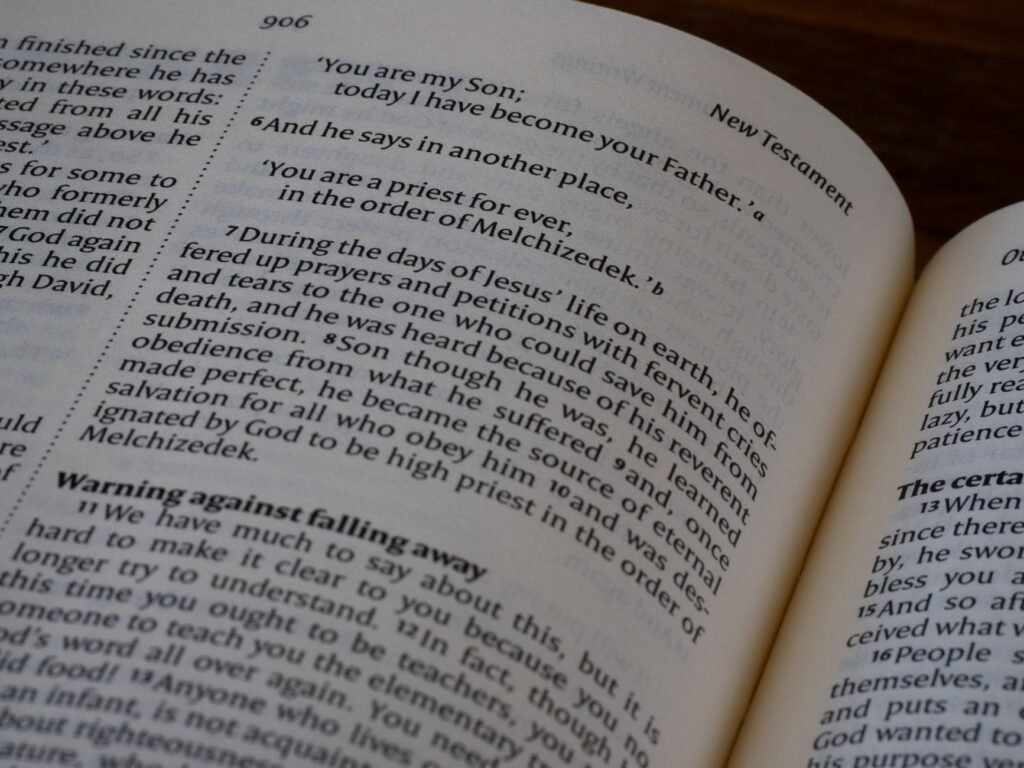
The New Testament writer to the Hebrews devotes several chapters to Melchizedek, arguing that he is a prototype of Jesus Christ. The author begins with, “As also the scripture says of him, ‘You are a priest forever after the order of Melchizedek.’” (Hebrews 5:6). By quoting the Psalm, the writer connects the Old Testament promise directly to the person of Christ.
In Hebrews 7:1‑three the author recounts the Genesis account and adds theological depth: “For this Melchizedek, king of Salem, priest of the Most High God, who met Abraham returning from the slaughter of the kings and blessed him… He is without father or mother, without genealogy, having neither beginning of days nor end of life, but resembling the Son of God he remains a priest forever.” The claim that Melchizedek “has neither beginning of days nor end of life” is not a literal historical statement but a typological observation: his lack of recorded lineage mirrors the Son of God’s eternal nature.
The writer continues in Hebrews 7:11‑fourteen to contrast the Levitical priesthood with the Melchizedekian priesthood: “If the perfection of the priesthood were through the Levitical priesthood, then it would have been necessary for a priest to die… But the priesthood according to the order of Melchizedek was a priesthood without a beginning of days.” Here the argument is that the old covenant’s priesthood, based on ancestry and death, could not achieve the perfection required for true mediation between God and humanity. Only a priesthood “without a beginning of days” can fulfill that role, pointing to the eternally existing Christ.
Further, Hebrews 6:20 declares, “We have a priest who is in heaven, and not the priest of the law,” emphasizing that Jesus, as the heavenly high priest, operates in a realm beyond the temporal Levitical system. The author’s theological conclusion is clear: Christ embodies the eternal, king‑priest order that Melchizedek foreshadowed.
Theological Implications: What Melchizedek Teaches About God’s Covenant
Melchizedek’s appearance raises several doctrinal considerations. First, his dual role challenges the assumption that priesthood must be hereditary. By highlighting a priesthood “after the order of Melchizedek,” Scripture invites believers to see God’s covenant as ultimately centered on Christ, not on tribal descent.
Second, the tithe that Abraham gives (Genesis 14:20) illustrates a pattern of acknowledgment and worship directed toward the true source of blessing. In a modern context, this can be understood as an invitation to offer our “firstfruits”—time, resources, or talents—to the One who blesses us, acknowledging His sovereignty.
Third, the “bread and wine” that Melchizedek offers prefigures the Eucharistic elements instituted by Christ. While the New Testament does not explicitly link Melchizedek to the Lord’s Supper, many theologians see a typological connection, especially given the shared themes of covenantal fellowship.
Finally, the absence of a genealogy for Melchizedek underscores a biblical principle: God’s purposes often operate outside human expectations. The writer of Hebrews notes that “the divine authority of the priesthood is transferred to Jesus” (Hebrews 7:13), showing that God can establish a covenantal order through means that surpass conventional structures.
Practical Lessons for Today’s Believer
Consider a contemporary scenario: a small church community decides to host a neighborhood dinner after a local crisis. The pastor, acting as both organizer (a “king” of the event) and spiritual guide (a “priest”), serves bread and wine while offering a prayer of blessing over the attendees. This act mirrors Melchizedek’s provision of bread and wine and his blessing over Abram. The congregation also chooses to give a portion of the collected funds to a charitable cause, echoing Abram’s tithe. In doing so, the church demonstrates that the ancient pattern of honoring God through hospitality, worship, and generosity remains relevant.
Moreover, believers can reflect on the “order of Melchizedek” in personal worship. Since Melchizedek represents a priesthood not bound by lineage, each Christian, regardless of background, can approach God confidently, knowing that Christ—our eternal high priest—has opened direct access (Hebrews 6:20). This encourages a personal, intimate relationship with God that is not mediated by human hierarchies.
For those seeking deeper study, resources such as
Keep Exploring Scripture
Continue your Bible study with our collection of Scripture tools, topics, people, places, and study resources.
Explore Bible Study ToolsYou May Also Like
Understanding Biblical Hospitality in a Digital Age
Exploring how Scripture defines hospitality, why it matters today, and practical ways to practice…
Applying the Parable of the Talents to Today’s Career Decisions
Discover how the timeless lesson of the talents can shape wise, faithful, and purposeful…

What Does the Bible Say About Managing Money and Generosity in Modern Times?
Exploring biblical principles of stewardship, wise spending, and generous giving, this article shows how…

How Should Christians Respond to Political Propaganda?
Navigating modern political propaganda demands biblical wisdom, discernment, and a heart anchored in truth.…

Why Do Conspiracy Theories Spread Among Christians?
An exploration of the biblical, psychological, and cultural factors that make believers vulnerable to…
Why Are Christians Vulnerable to Conspiracy Theories?
Exploring the biblical roots of our desire for hidden explanations, this article examines why…
Join the Conversation