
What Role Did Women Play in the Early Church According to Scripture
An in‑depth biblical survey shows how women served as witnesses, leaders, teachers, and disciples in the first centuries of the Christian movement, grounded in the text of Scripture.


Introduction: Setting the Question
The role of women in the early church has long been a focal point for scholars, pastors, and lay believers who seek to understand how New Testament revelation shapes contemporary practice. The New Testament provides a mosaic of data: women as the first witnesses to the risen Lord, as financial supporters who opened their homes for gathering, as prophetic voices in the assembly, and as individuals who held recognized offices such as deaconess. At the same time, the apostolic letters contain normative instructions that appear to limit certain functions. To engage the topic responsibly, we must let the biblical text speak for itself, placing each verse within its literary genre, historical circumstance, and theological trajectory. In the sections that follow, each claim is anchored in a specific verse or passage, quoted accurately, and examined alongside related scriptures that illuminate the broader picture. The aim is not to resolve every scholarly dispute, but to offer a warm, scholarly overview that equips readers to discern the biblical portrait of women’s service and to apply it with wisdom today.
Women as the First Witnesses of the Resurrection
The gospel accounts unanimously record that women were the first to encounter the empty tomb. In the Gospel of Matthew the angel says, “Fear not: for I know that ye seek Jesus, which was crucified. He is not here: for he is risen, as he said” (Matthew 28:5‑6). The Gospel of Mark adds the detail that the women “saw the stone rolled away” (Mark 16:4) and that “they fled from the tomb, for they trembled and were amazed” (Mark 16:8). The Gospel of Luke records that “the women … told these things unto the eleven and to all the rest” (Luke 24:10). The Gospel of John emphasizes Mary Magdalene’s early visit, “while it was yet dark … saw that the stone was taken away” (John 20:1). In each case, the women are the primary informants to the disciples, a striking narrative choice given the first‑century Jewish legal principle that a woman’s testimony required corroboration (Deuteronomy 19:15). The gospel writers therefore preserve a counter‑cultural fact: the proclamation of the resurrection began with women.
Paul’s creedal confession in First Corinthians 15:3‑8 also affirms that “the women … were the first to see the risen Lord” (First Corinthians 15:8). By placing the women at the forefront of the resurrection narrative, the New Testament emphasizes that the power of God’s victory over death does not discriminate on the basis of gender, social status, or ethnicity. Theologically, the empty tomb narrative shows that the power of God’s resurrection transcends social boundaries, allowing those marginalized in the surrounding culture to become bearers of the best news.
A contemporary illustration can be seen in a small Appalachian church where a widowed grandmother, Martha, organized a sunrise service after the Easter sunrise service. She invited the youth group to join, and her testimony about the empty tomb sparked a renewed interest in Scripture study among the teenagers, demonstrating that the ancient pattern of women as first messengers continues to bear fruit. In another example, a college campus ministry in the Midwest reported that a sophomore woman, Leah, led a small group in sharing the resurrection story with her dorm‑room neighbors; the group’s rapid growth mirrored the early church’s experience of women catalyzing evangelistic momentum.
Women Who Supported the Apostolic Ministry
The Book of Acts records several women who offered their homes, finances, and hospitality to the missionary enterprise. Lydia of Thyatira, a dealer in purple cloth, “when the Lord opened her heart, she received the word” (Acts 16:14) and, together with her household, was baptized (Acts 16:15). She “urged us, saying, If you have judged me to be faithful to the Lord, come into my house and abide there” (Acts 16:15). Her home became a gathering place for believers, an early model of the house‑church. In the same chapter, a woman named “the leading lady of the house of Philemon” (Philemon 1:2) is commended for her generous assistance to the apostle Paul, indicating that women’s support extended beyond hospitality to material aid.
Priscilla, mentioned alongside her husband Aquila, “found a certain Jew named Aquila, born at Pontus, lately come from Italy with his wife Priscilla” (Acts 18:2). Later they “went into the house of a certain disciple named Apollos, and having laid hands on him, explained to him the way of God more accurately” (Acts 18:26). Although the passage names both spouses, the ordering of Priscilla’s name before Aquila has been noted by commentators such as Douglas Moo as an indication of her prominent role in the teaching ministry. In the Pauline epistles, Phoebe is described as “a deaconess of the church which is at Cenchrea” (Romans 16:1) and Paul urges the Roman believers to “receive her in the Lord as a sister, and to give her such assistance as ye may have need of” (Romans 16:2). The Greek term diakonos, translated “deacon” or “deaconess,” denotes an official service position.
Additional examples include the widows who supported the prayer ministry in First Timothy 5:9‑10, where Paul instructs the church to “provide for widows who are truly widows.” The early Christian community’s willingness to care for widows underscores a broader pattern of women both receiving and extending care within the body of Christ.
A modern real‑life scenario illustrates the continuity of this pattern. In a growing suburban church in Texas, a married couple, Elena and Marco, host a weekly “Makers’ Night” in their living room, providing space, snacks, and technical assistance for a small group of artists who create worship media. Elena also coordinates a “Women’s Giving Circle” that funds missionary trips. Their partnership reflects the biblical precedent that women’s hospitality and financial stewardship can be vital to the spread of the gospel. A similar example can be observed in a church plant in Nairobi, where a woman named Amina runs a community kitchen that feeds both believers and the surrounding neighborhood, echoing the generosity of Lydia and the unnamed women of Acts.
Women as Prophets and Speakers in Early Gatherings
The New Testament records women exercising prophetic gifts. In Acts 21:9 we read, “Now when we were at Cenchrea, we found a prophetess, named Philip’s daughter, named Euodia.” While the narrative does not elaborate on Euodia’s ministry, the very identification of a female prophet confirms that prophetic activity was not restricted to men. In the Corinthian correspondence, Paul addresses the practice of women praying and prophesying in the assembly: “But every woman that prayeth or prophesieth with her head uncovered dishonoureth her head” (First Corinthians 11:5). The passage assumes that women were actively engaged in public prayer and prophecy, prompting Paul to give instructions concerning head coverings as cultural symbols of authority.
The presence of women in the prophetic role is further supported by the mention of “the daughters of Philip” who “prophesied” (Acts 21:9) and by the fact that the early church’s “gift of prophecy” is listed among the “working of miracles” in First Corinthians 12:10, a list that the early church understood to include both male and female participants. Additionally, the Samaritan woman at the well, though not a prophet, “went out and told many of the Jews” (John 4:39), indicating a pattern of women being sent to share the good news.
Another biblical prophetess worth noting is Anna, the elderly widow who “served God with fasting and prayer night and day” (Luke 2:36) and “spoke of the child to all who were looking for the redemption of Jerusalem” (Luke 2:38). Her public proclamation in the temple demonstrates that the Spirit empowered women to bear witness in highly visible settings.
In contemporary ministry, the example of a university chaplaincy team led by a female chaplain, Dr. Aisha, demonstrates the ongoing relevance of prophetic proclamation. Dr. Aisha regularly leads “prophetic prayer nights,” encouraging participants to listen for the Holy Spirit’s leading. The team reports that many students have testified to experiencing personal transformation after hearing God speak through women’s prayer. This modern illustration shows that the early church’s openness to women speaking under the Spirit can find authentic expression today, especially when guided by the biblical principle that gifts are distributed “to each one as he will” (First Corinthians 12:11).
Paul’s Instructions Concerning Women in Worship and Teaching
The pastoral letters contain passages that appear to limit women’s participation in certain roles. First Timothy states, “Let the woman learn in silence with all subjection. But I suffer not a woman to teach, nor to usurp authority over a man: but to be in silence” (First Timothy 2:11‑12). The Greek term hesuchē, rendered “silence” or “quietness,” may refer to a decorous posture rather than an absolute prohibition of all teaching. The context of this instruction includes a discussion of false teaching that was infiltrating the church (First Timothy 1:3‑4), suggesting that the directive addresses a particular situation.
Paul further grounds his argument by referencing the creation order, stating “For Adam was first formed, then also the woman” (First Timothy 2:13) and “And Adam was not deceived, but the woman being deceived was the source of transgression” (First Timothy 2:14). Some scholars argue that Paul is appealing to a cultural understanding of authority rather than prescribing a timeless restriction. The New Testament also records women who taught in the early house churches, such as the older women in Titus 2 who “teach what is good” (Titus 2:3‑5), indicating that the prohibition was not universal.
Similarly, First Corinthians 14:34‑35 says, “Let the women keep silent in the churches: for it is not permitted unto them to speak; but they are commanded to be under obedience as also the law says. And if they will learn any thing, let them ask their husbands at home.” This instruction is embedded within a passage about orderly worship and the regulation of spiritual gifts. Many commentators, such as Gordon Fee, argue that Paul is responding to specific disruptions rather than establishing a universal, timeless ban. The immediate context includes an appeal to “the saints” to “earnestly desire to prophesy” (First Corinthians 14:1), which presupposes the participation of women in prophetic speech.
To illustrate how these passages can be applied with pastoral sensitivity, consider a mid‑size Baptist congregation in Ohio. The church’s leadership convened a study group to examine the relevant texts, consulting both the historical background of first‑century worship and the broader biblical narrative of women’s service. The group concluded that while the instruction in First Timothy addresses a specific cultural problem of unsound teaching, it does not preclude women from teaching in contexts where they are qualified and where the teaching is exercised with humility and respect for the authority structure outlined in Scripture. This example demonstrates a balanced approach that honors the text while also recognizing the gifts present in the body of Christ.
The Principle of Equality in Christ
Beyond situational instructions, the New Testament declares a radical theological truth about identity in Christ: “There is neither Jew nor Greek; there is neither bond nor free; there is neither male nor female: for ye are all one in Christ Jesus” (Galatians 3:28). This verse does not erase cultural distinctions for the purpose of civil order, but it affirms that the salvific work of Christ eliminates any hierarchical status in the realm of spiritual identity. Paul’s affirmation of “one in Christ” provides a foundational lens for interpreting other passages concerning gender.
Additional passages reinforce this egalitarian principle. In the first letter to the Philippians, Paul writes, “I count all things but loss for the excellence of the knowledge of Christ Jesus my Lord” (Philippians 3:7‑8), a statement that underscores the value of every believer regardless of gender. The epistle to the Romans includes the commendation of Junia, “who is outstanding among the apostles” (Romans 16:7). The identification of Junia, a woman, as an apostle challenges any notion that the highest offices were exclusively male.
The pastoral epistle to Ephesians adds, “Submit to one another out of reverence for Christ” (Ephesians 5:21), a mutual submission that applies equally to men and women and therefore shapes how authority is exercised in the local church. Moreover, First Peter exhorts husbands to “dwell with your wives in an understanding way” (First Peter 3:7), indicating that the biblical ethic calls for reciprocal honor.
A modern illustration can be found in a mission organization that appoints both men and women as field directors. One such director, Sister Miriam, oversees a network of churches in West Africa, coordinating evangelistic training, church planting, and community development. Her leadership is affirmed by the organization’s board, which cites the biblical principle of “one in Christ” as the theological basis for her appointment. This example shows how the doctrinal truth of equality in Christ can be lived out in concrete leadership structures. For those seeking further study on the theological implications of Galatians 3:28, a helpful resource is available at Got Questions, which explores the topic in depth.
Women in Church Leadership and Governance in the Pastoral Epistles
The pastoral epistles provide further insight into women’s recognized service. In First Timothy 3:11 the author exhorts, “In the same way, the women are to be reverent, not malicious talkers, but temperate, faithful in all things.” This verse is understood by many scholars to refer to the wives of deacons, suggesting that women were expected to exhibit qualities consistent with ministry service. The Greek term diakonos, used of men in the same chapter (First Timothy 3:8‑9), appears again in Romans 16:1 where Phoebe is called “a deaconess.” The parallel usage indicates that the early church recognized a formal office for women, at least in the sense of service and leadership.
Furthermore, the letter to Titus instructs older women to “teach what is good” (Titus 2:3‑5). The phrase “teach good things” (didaskō agathon) implies a pedagogical function within the house‑church context. The instruction that “the older women likewise be reverent in behavior, not slanderers, not given to much wine, but sound teachers” (Titus 2:3‑5) establishes a normative role for mature women in nurturing the spiritual growth of younger women and children. The combination of these passages suggests a pattern: women were expected to contribute to the teaching and oversight of the local congregation, particularly in the home setting.
Historical evidence outside the New Testament also points to women holding leadership positions. The early church father Clement of Alexandria notes that “women of the church have been appointed to oversee the widows” (Stromata 1:12), echoing the biblical model. In a contemporary setting, a church plant in rural Indiana has an officially recognized “Women’s Discipleship Team,” led by a longtime member named Grace. The team meets weekly in the church’s fellowship hall
Keep Exploring Scripture
Continue your Bible study with our collection of Scripture tools, topics, people, places, and study resources.
Explore Bible Study ToolsYou May Also Like

What Does Scripture Say About Environmental Stewardship?
Exploring biblical principles of creation care, this post examines how Scripture frames humanity’s responsibility…

How to Develop a Consistent Daily Bible Reading Habit When Life Gets Chaotic
Discover practical, Scripture‑grounded steps for building a reliable daily Bible reading routine even amid…
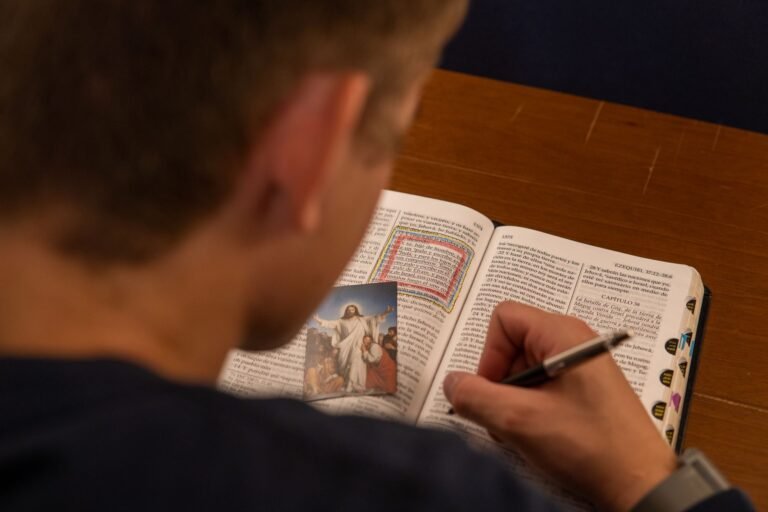
Can God Guide Us Outside of Scripture?
Exploring how the Holy Spirit, creation, conscience, and godly counsel can complement the Bible’s…
What Is the Story of Scripture?
A look at how the Bible weaves a single, redemptive narrative from creation to…
How to Read the Old Testament as a Christian: Finding Christ in Ancient Pages
Discover how to approach the first thirty-nine books of the Bible with theological clarity,…
How to Study the Book of Psalms: A Guide to the Prayerbook of the Bible
Discover how to interpret the poetic structure, historical context, and rich theological genres of…
Join the Conversation